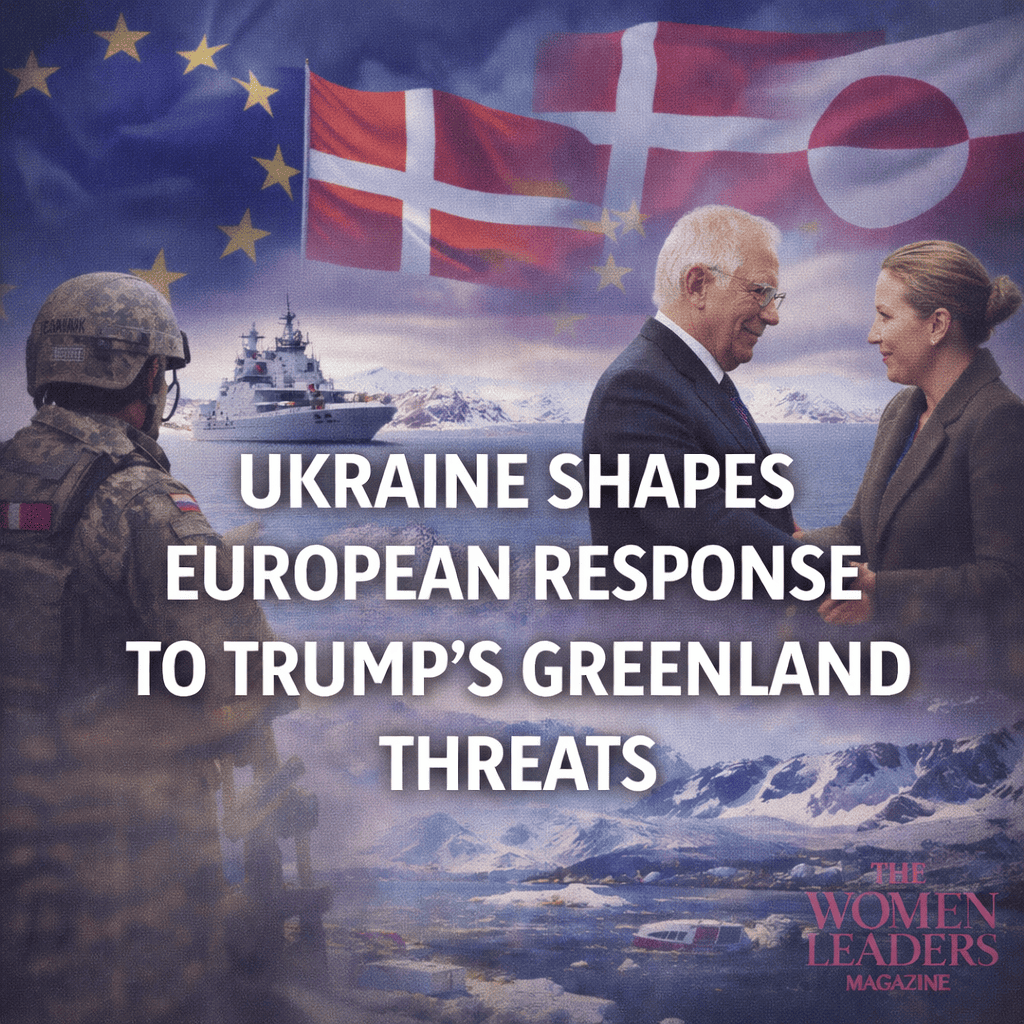
The European response to Trump’s Greenland threats is being shaped less by Arctic strategy than by the ongoing war in Ukraine. European leaders are weighing how firmly they can push back against Washington’s rhetoric without endangering US military and diplomatic backing for Kyiv. That dependence has turned what might otherwise be a straightforward sovereignty dispute into a delicate balancing act.
Publicly, European governments have been clear. Statements from Denmark and a group of major EU capitals stress that Greenland’s future can be decided only by Greenland and Denmark, and that territorial integrity is not negotiable. The message reflects a broader defence of international law, a principle Europe has elevated since Russia invaded Ukraine. In that sense, the European response to Trump’s threats over Greenland mirrors the language used to oppose territorial coercion elsewhere.
Behind the scenes, however, Ukraine is shaping tone and timing. European officials are conscious that confrontation with Washington over Greenland could spill into other areas, particularly Ukraine’s security. The EU continues to rely heavily on US weapons supplies, intelligence, and diplomatic leverage to contain Russia and to shape any future settlement. That reality limits how far Europe can escalate its response, even as Washington’s rhetoric sharpens.
This caution is evident in how leaders frame their objections. Rather than directly attacking US intentions, European statements emphasise legal process, consent, and alliance unity. The European response to Trump’s Greenland threats avoids personalised criticism and instead anchors objections in shared rules and NATO values, a strategy designed to reduce the risk of retaliation on unrelated fronts.
Ukraine has also altered Europe’s tolerance for risk. Since 2022, EU governments have learned that strategic ambiguity from Washington can carry high costs. As a result, European leaders are reluctant to provoke a dispute that could weaken transatlantic coordination at a moment when unity remains critical. This explains why the European response to Trump’s threats over Greenland has been firm in principle but restrained in its delivery.
Several governments are now exploring ways to defuse the issue without conceding sovereignty. One approach under discussion involves expanding joint Arctic security cooperation within existing defence agreements, addressing US security concerns while reinforcing Danish and Greenlandic authority. Another avenue is economic: deeper EU–Greenland partnerships on infrastructure and critical minerals could reduce external pressure by strengthening Greenland’s own strategic options. (Speculation: these initiatives may be accelerated to remove leverage from sovereignty disputes.)
Ukraine’s influence also extends to diplomatic sequencing. European officials are keen to ensure that tensions over Greenland do not contaminate talks on Ukraine security guarantees or post-war arrangements. Maintaining parallel channels—one for Arctic issues, another for Ukraine—has become a priority in managing the European response to Trump’s threats over Greenland.
Ultimately, Ukraine does not dilute Europe’s defence of Greenland. It explains why the response is measured. The European response to Trump’s Greenland threats reflects a strategic calculation: defend borders and the rule of law unequivocally, while preserving the US partnership that remains essential to Europe’s security architecture.