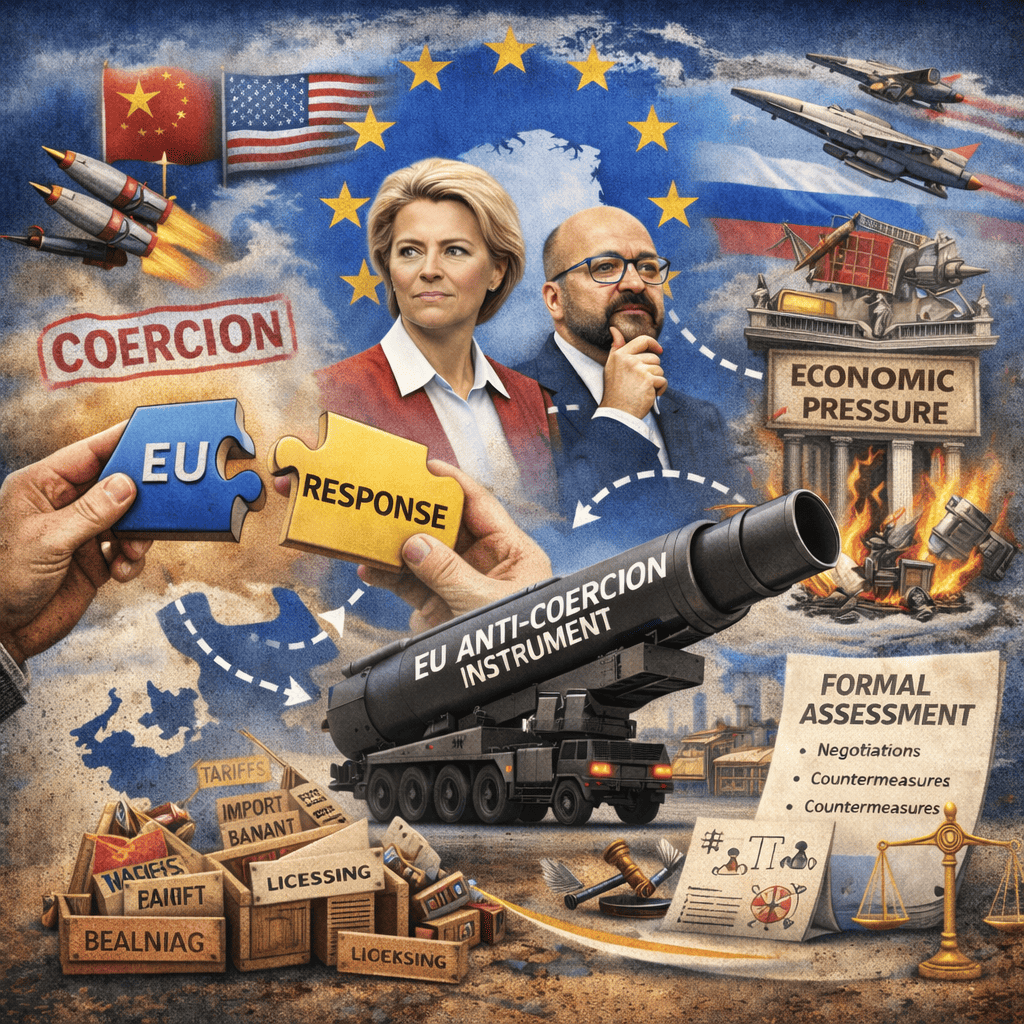
The EU anti-coercion instrument is the European Union’s legal answer to a growing problem in global politics: governments using trade pressure to force political change. It entered into force in late 2023 and was designed for moments when tariffs, import bans, licensing hurdles, or investment barriers are deployed not as part of routine trade disputes, but as leverage to bend the EU or one of its member states to a foreign government’s will.
Under the EU anti-coercion instrument, coercion is defined by intent and effect. The measure must aim to influence a sovereign choice—foreign policy, regulation, territorial questions, or strategic alignment—by inflicting or threatening economic harm. This distinction matters. Normal trade disagreements fall under WTO rules. Coercion, in contrast, is about power.
The mechanism is structured as a controlled escalator. First, the European Commission collects evidence and maps the coercive act: who is targeted, what economic tools are being used, and what policy change is being demanded. The Commission then conducts a formal assessment to determine whether the situation meets the legal threshold. This phase can take months, a design choice meant to ensure precision and proportionality rather than reflex.
If coercion is confirmed, member states step in. Decisions are taken by qualified majority, preventing a single capital from blocking EU action. The EU anti-coercion instrument then prioritizes negotiation. Brussels opens talks with the third country, using the prospect of countermeasures as leverage. The goal is withdrawal of the coercive measure, not retaliation for its own sake.
Only when diplomacy fails does the EU act. Here, the EU anti-coercion instrument reveals why it is often described as a “trade bazooka.” Countermeasures can go far beyond tariffs. They include restrictions on access to EU public procurement, quotas or licensing limits on imports and exports, constraints affecting services and investment, and other tailored limits on single-market access. These tools target areas where modern economies are most sensitive: contracts, services, and long-term market presence.
What makes the instrument strategically valuable is its ability to be used even before retaliation. Opening a formal assessment signals resolve. Publishing an evidentiary record reframes the dispute as coercion rather than commerce. Designing graduated response lists—procurement first, goods next, services last—creates a visible off-ramp for de-escalation. The EU anti-coercion instrument can therefore function as a deterrent architecture, not merely a punishment regime.
The political question now is speed versus restraint. Critics argue that long timelines blunt deterrence in an era of rapid escalation. Supporters counter that credibility comes from legality and unity, not haste. Either way, the EU anti-coercion instrument marks a shift in European trade policy: from reactive rule enforcement to strategic power balancing. It turns the single market itself into leverage—and signals that economic pressure aimed at sovereign choices will no longer be cost-free.