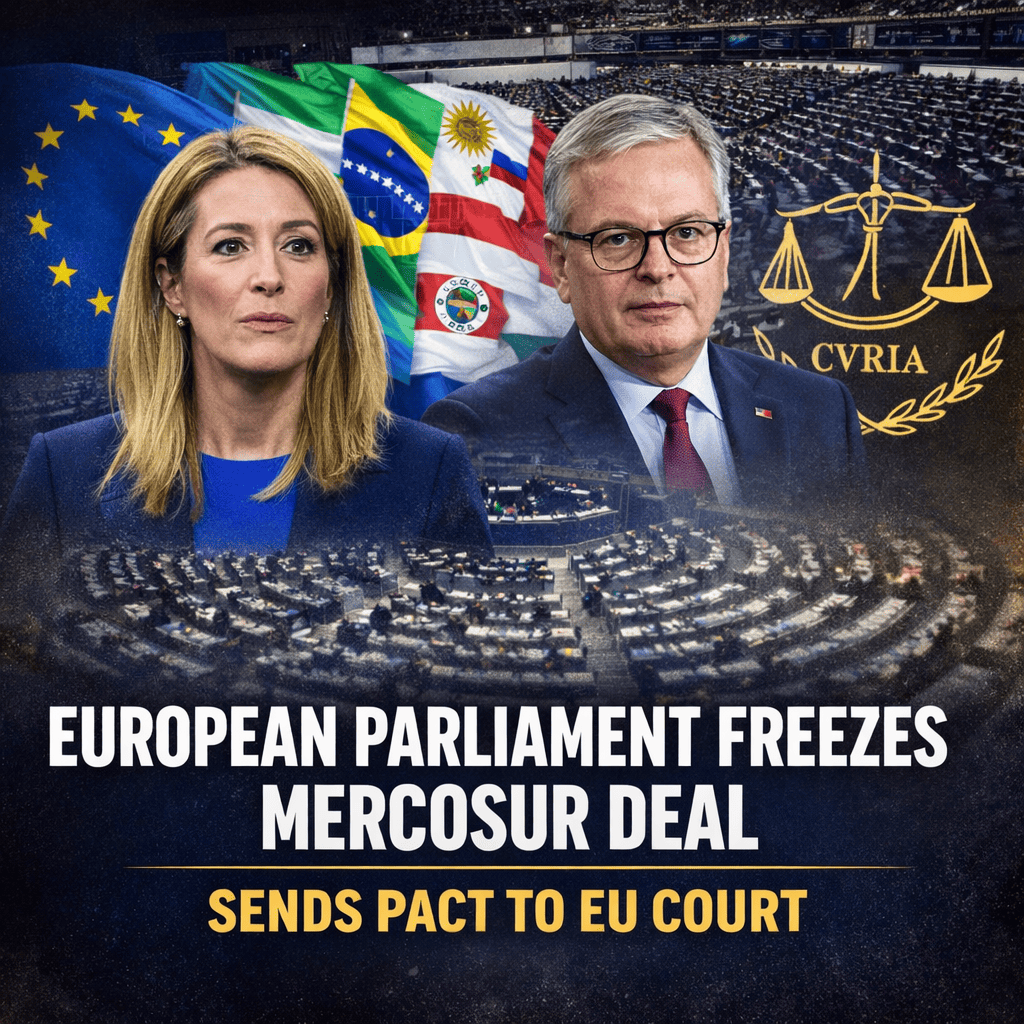
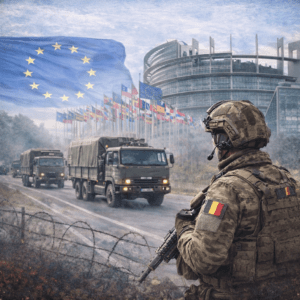
European Parliament freezes Mercosur deal after a knife-edge vote in Strasbourg to refer the EU–Mercosur agreement to the EU Court of Justice, effectively pausing ratification while judges decide whether Brussels is using the correct legal pathway. The move could delay the pact for months, potentially up to 2 years, in what would be the longest legal pause the deal has faced since negotiations began more than 2 decades ago.
The vote passed by a narrow margin, exposing how fragile political support remains even after the agreement was formally signed. At stake is not the content alone, but the process. Lawmakers want the Court to clarify whether the deal can be treated as an EU-only agreement—allowing faster approval—or as a “mixed” agreement that every national parliament must ratify. That distinction determines speed, risk, and political exposure across 27 member states.
Supporters frame the agreement as strategic insurance. It links the EU with Argentina, Brazil, Paraguay, and Uruguay, opening access to fast-growing markets, lowering tariffs on industrial goods and agricultural products, and reducing dependence on more volatile trade partners. In a fragmented global economy, they argue, Europe cannot afford to leave this corridor idle.
Opponents counter that economics is not the only ledger. They warn that the pact could undercut EU farmers, expand imports of beef and sugar produced under different standards, and weaken Europe’s leverage on deforestation, animal welfare, and food safety. For them, the European Parliament’s freeze on the Mercosur deal is a necessary brake, proof that trade cannot outrun climate and social policy.
Legally, the referral also reflects anxiety over regulatory autonomy. Lawmakers want assurance that the agreement will not constrain the EU’s ability to set future rules in areas such as environmental protection and consumer health. The Court’s answer will shape not just Mercosur, but how future mega-deals are structured.
In practice, European Parliament freezes Mercosur deal does not terminate the pact. It transforms it into a legal and political project. The European Commission could still explore provisional application of chapters within clear EU competence, but doing so while a Court review is pending raises risks for companies planning compliance and for governments selling the deal at home.
Three paths could shorten the stalemate:
- Publish a clean sequencing map—chapter by chapter—showing what could apply provisionally and what must wait. Businesses need certainty, not headlines.
- Add enforceable guardrails—pair ratification with measurable deforestation and standards mechanisms, including penalties that trigger automatically.
- Use tech to depoliticize trust. Satellite monitoring and digital traceability can verify supply chains in near-real time, turning sustainability from promise into proof.
For now, the European Parliament freezes Mercosur deal is the reality. It signals that EU trade policy is no longer driven solely by negotiators. Courts, farmers, climate politics, and national parliaments now sit at the same table—and every future agreement will have to clear them all.