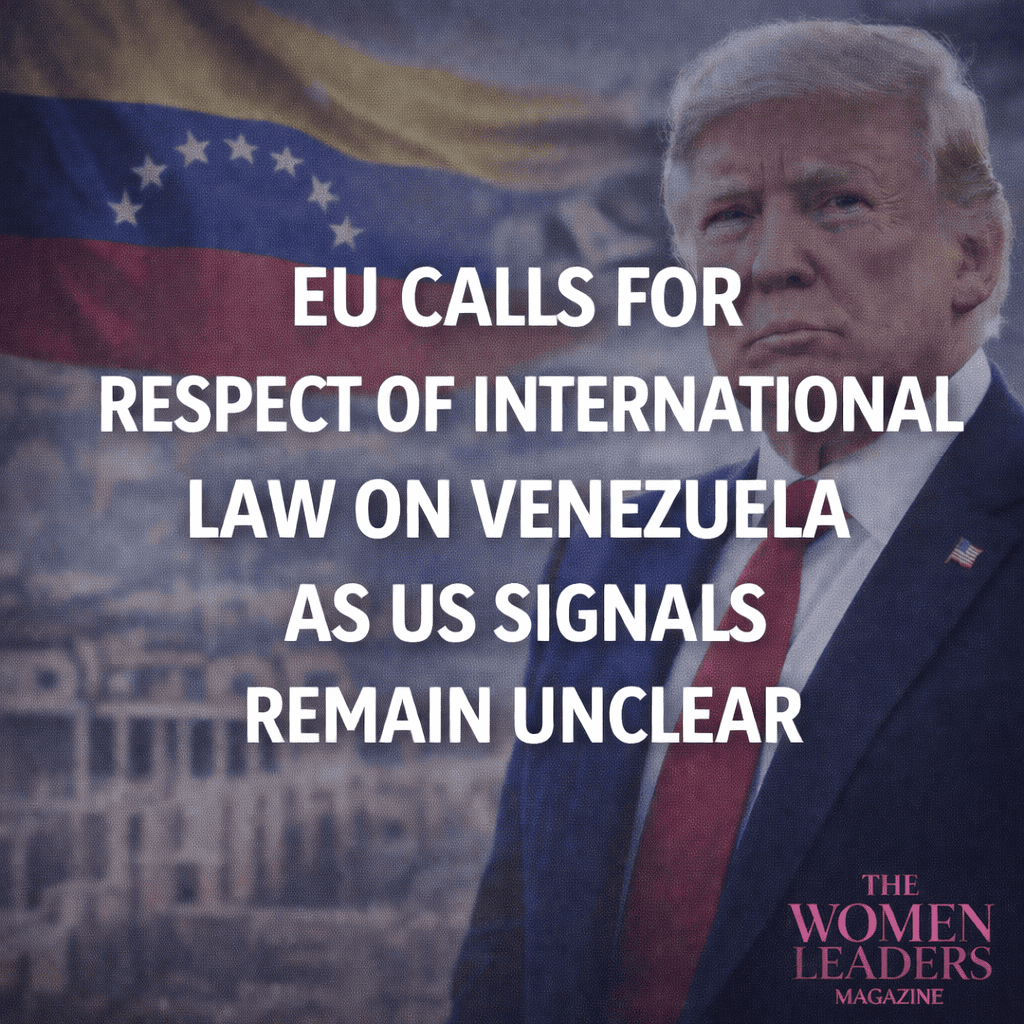
The EU calls for respect of international law on Venezuela following the US-led operation that removed President Nicolás Maduro, as European leaders distance themselves from any endorsement of force and stress the need for a lawful, Venezuelan-led transition. Brussels’ position highlights growing unease over Washington’s lack of a clearly articulated political roadmap.
Speaking on behalf of the bloc, EU foreign policy chief Kaja Kallas urged restraint and reaffirmed that any change in Venezuela’s leadership must comply with the UN Charter and international law. The statement reflects a deliberate attempt to separate Europe’s support for democratic change from the methods used to pursue it. For Brussels, the EU’s call for respect for international law on Venezuela is not rhetorical caution but a core condition for legitimacy.
The declaration was backed by 26 EU member states, underscoring a broad consensus despite persistent internal divisions. Hungary was the sole country not to endorse the text, illustrating how sensitive foreign-policy alignment remains when the United States is directly involved. Still, the EU’s call for respect for international law in Venezuela garnered near-unanimous backing, signaling a strong collective stance.
A key source of friction is Washington’s lack of clarity. President Donald Trump has avoided outlining what a Venezuelan transition should entail, leaving unanswered questions about governance, elections, and international oversight. European officials argue that without a defined political framework, any shift risks instability rather than reform. This uncertainty explains why the EU’s call for respect of international law on Venezuela has become Brussels’ central message.
European Commission officials have described the moment as a potential opening for democratic change, but only if legal norms are upheld and violence avoided. The EU’s cautious tone contrasts with the assertive US approach and reflects concern about precedent. Legal scholars warn that the forced removal of a sitting leader could weaken international norms if left unchallenged, underscoring why the EU’s call for respect for international law in Venezuela resonates beyond this single crisis.
The EU is also mindful of regional consequences. Latin American governments have expressed mixed reactions, with some welcoming political change while others warn against external intervention. Brussels sees value in a coordinated diplomatic effort involving regional actors, the UN, and international observers to anchor any transition in legitimacy rather than power dynamics.
Several policy options remain available to Europe. A phased approach combining humanitarian stabilisation, guarantees for political participation, and internationally monitored elections could provide structure without endorsing unilateral action. Adjusting sanctions to protect civilian welfare while maintaining pressure on corruption and abuses may also help stabilise the situation. (Speculation: the EU may push for a multilateral mediation framework to regain influence.)
Ultimately, the EU calls for respect of international law on Venezuela because Europe views lawful process as inseparable from democratic outcomes. Without it, Brussels fears that political change may deepen instability rather than resolve Venezuela’s long-running crisis.