Women rethinking career advancement in 2026 is not a confidence problem. It is a rational response to a system where “moving up” often means more ambiguity, more emotional labor, higher visibility risk, and less control over time. For many women, the cost of advancement no longer matches the return. This shift is already reshaping leadership pipelines, not because talent is lacking, but because the structure of advancement feels misaligned with how work and life now intersect.
Organizations that interpret this moment as a motivation gap will fail. The real signal is structural: women are evaluating leadership roles through a sharper lens. They are asking whether seniority brings agency or merely pressure, whether influence comes with protection or exposure, and whether growth is compatible with longevity.
What is changing in 2026
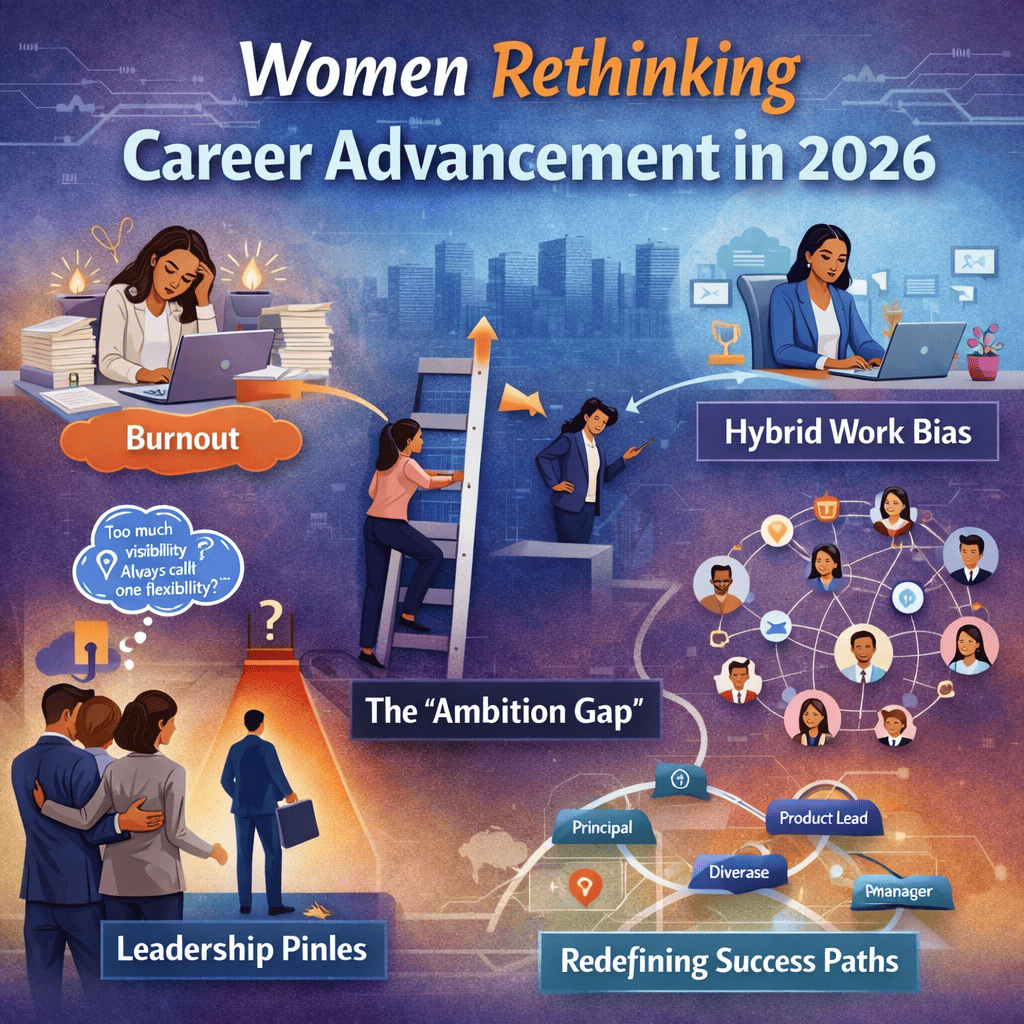
The modern promotion equation looks worse than it did even a few years ago. Senior roles increasingly combine broad scope with unclear authority. Expectations expand faster than resources. Visibility rises while error tolerance narrows. When people observe burned-out leaders, they internalize a simple message: leadership is expensive.
At the same time, many companies are quietly reducing the very mechanisms that made advancement viable—formal sponsorship, targeted development, and structured pathways into management. The message becomes contradictory: “We need more women leaders,” paired with fewer systems that help women get there.
Hybrid work adds another layer. Flexibility exists on paper, yet influence still concentrates in informal spaces. Decisions happen in side conversations. Presence becomes a proxy for commitment. The result is a new kind of exclusion that is harder to name and harder to challenge.
The first promotion remains the most fragile point in the pipeline. When early leadership roles are poorly designed—heavy administrative load, weak authority, unclear metrics—they repel exactly the people organizations claim to want. A broken first rung produces a long shadow: fewer women become eligible for every level above.
Why “less ambition” is the wrong diagnosis
Calling this a confidence issue relocates responsibility from systems to individuals. It is convenient and incorrect.
What women are doing in 2026 is recalibrating risk. They are comparing:
- The upside of promotion
- the probability of support
- the visibility penalty for mistakes
- The sustainability of the role
- The impact on health and personal agency
When any of these are misaligned, hesitation is rational.
Four forces drive this recalibration:
Uneven career support
Advancement rarely happens on performance alone. It depends on advocacy in rooms you are not in, access to stretch work, and protection after mistakes. When those are distributed unevenly, the next rung feels precarious.
Burnout as a role design outcome
Burnout is often framed as a resilience problem. In reality, it is a design failure. Roles that assume constant availability, absorb organizational anxiety, and lack clear boundaries select for people with fewer constraints and larger safety nets. Others opt out.
Higher cost of visibility
Visibility brings opportunity and scrutiny. For women, the penalty for error is often steeper. The same behavior that signals decisiveness in one person can be labeled abrasive in another. That asymmetry changes the perceived value of stepping forward.
Asymmetric readiness standards
Men are frequently evaluated on perceived potential; women on accumulated proof. Minor differences compound across years. Promotion becomes a hurdle race rather than a relay.
Together, these forces explain why women rethinking career advancement in 2026 is not a retreat. It is a strategic pause in a system that has not earned trust.
What it means for leadership
The implications are structural:
- A thinner future bench
- Not today, but soon. When fewer women pursue the next rung, succession pools narrow two to five years out.
- A credibility gap
- Stated commitments to gender balance ring hollow when leadership roles remain unsustainable.
- A talent market disadvantage
- High performers increasingly practice selective ambition—advancing in some seasons, consolidating in others. Companies that offer only one rigid path will lose people or keep them disengaged.
What actually changes outcomes
The response is not more programming. It is a redesign.
A. Treat career support like a core operating system
Make sponsorship explicit and measurable.
Mentorship offers advice. Sponsorship changes trajectories. Each senior leader should be accountable for advancing specific people with concrete outcomes: a stretch role, a visible project, a promotion-ready case: track results, not meetings.
Rebuild the first management role.
Entry leadership should be a gateway, not a punishment. Reduce spans of control. Clarify decision rights. Remove administrative drag. Equip new managers with the authority that matches their responsibilities.
B. Stop promoting people into exhaustion
Price invisible labor
Culture work, onboarding, emotional buffering, and “fixing” are often concentrated among high-performing women. Name it. Rotate it. Reward it. Otherwise, it becomes a tax on advancement.
Make flexibility a leadership benefit.
Flexibility should increase with seniority, not disappear. Define hybrid protocols: decision logs, meeting equity rules, outcome-based evaluation. Influence must not depend on proximity.
C. Replace the ladder with a lattice
Growth does not have to equal people management.
Create roles that expand pay, influence, and scope without forcing a managerial identity: principal tracks, product leadership, program ownership, client leadership with protected patterns.
Say publicly that these paths are prestigious. When multiple outcomes signal success, women rethinking career advancement in 2026 becomes a redistribution of talent, not a loss.
Speculation (flagged): Over the next three years, more organizations will experiment with time-bounded leadership—12–24 month senior assignments with status and compensation, without permanent identity shifts. This lowers the psychological cost of trying leadership.
D. Use technology to equalize access
Internal talent marketplaces
Publish high-impact projects with precise skill requirements and time bounds. Let people opt in. Reward managers for exporting talent. This reduces “who you know” bias.
AI for career navigation—paired with structure
Use AI to map skills, simulate roles, and refine promotion narratives. Pair it with standardized promotion rubrics so judgment remains evidence-based.
E. Redesign evaluation to reduce “potential bias.”
Shift from impression to artifacts: outcomes, complexity, stakeholder impact. Standardize promotion packets—train panels to detect gender-specific language patterns. Structure beats awareness.
What can women leaders do without carrying the system?
- Build a portfolio of power: one business-critical metric, one visible forum, one sponsor, one peer coalition.
- Negotiate role design, not just title: decision rights, headcount, budget, meeting load, travel boundaries.
- Use selective ambition strategically: choose timing, protect longevity, expand scope laterally when vertical movement is mispriced.
This is not opting out. It is a choosing trajectory.
The mandate for 2026
If leadership teams want more women to pursue advancement, the path is clear:
- Equalize career support.
- Make leadership sustainable.
- Fix the first rung.
- Modernize what “success” looks like.
- Make hybrid work structurally fair.
When those change, women rethinking career advancement in 2026 stops being a warning sign and becomes a strategic evolution—women advancing on terms that produce stronger leaders and healthier organizations.