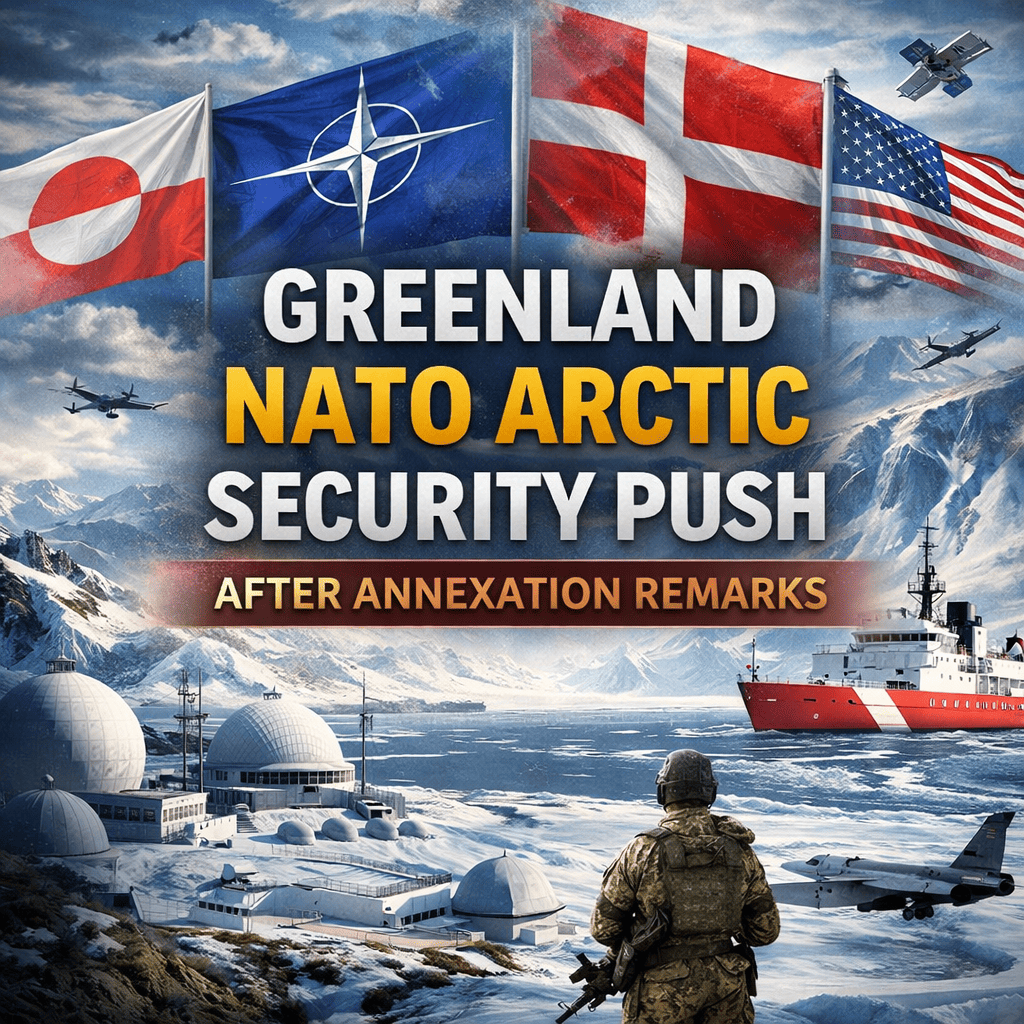
The Greenland NATO Arctic security push has entered a new phase as Greenland’s government and NATO leaders signal concrete steps to reinforce security across the Arctic. The move follows renewed remarks by US President Donald Trump suggesting that Washington could seek control over the island, triggering firm responses from both Nuuk and European capitals.
Greenland sits astride critical Arctic air and sea corridors and hosts key US military infrastructure, including the Pituffik Space Base. As melting ice opens new shipping routes and access to resources, the island’s strategic value has surged. Russia’s military expansion in the High North and China’s growing Arctic ambitions have already pushed the region into the centre of global competition. Trump’s comments have now added an internal alliance dimension to that tension.
NATO Secretary General Mark Rutte confirmed that the alliance is working on “next steps” to strengthen its Arctic posture, with early discussions ranging from enhanced surveillance to a more structured NATO presence in the region. While no formal mission has been announced, diplomats describe momentum toward a visible, multilateral security framework that removes ambiguity about who guarantees Greenland’s defence.
Greenland’s leadership has been unequivocal: sovereignty is not negotiable. Officials have stressed that any defence arrangement must operate through NATO and Denmark, rejecting the notion of any single power exercising bilateral control. As part of the Kingdom of Denmark, Greenland is already under NATO’s umbrella, aligning with the natural channel for security planning.
European officials have warned that any coercive move against Greenland would fracture the alliance itself. The message from Brussels and Nordic capitals is that the issue is not just territorial—it is institutional. If an ally can be pressured over sovereignty, the credibility of NATO’s collective defence erodes across every border.
The Greenland NATO Arctic security push is therefore being shaped as deterrence without provocation. Options under discussion include:
- Expanded aerial and maritime monitoring across Arctic approaches
- Rotational allied patrols to increase presence without permanent basing
- Hardening of ports, runways, cables, and satellite links
- A standing NATO coordination cell focused on Arctic defence planning
These steps aim to make Greenland harder to isolate, harder to pressure, and politically impossible to treat as a bilateral acquisition target.
The strategic logic is simple: visibility replaces vulnerability. By embedding Greenland’s security firmly within alliance structures, NATO removes the grey zones that invite speculation and brinkmanship. The goal is not militarisation, but clarity—about sovereignty, responsibility, and response.
As Arctic routes become commercially viable and geopolitically contested, the island’s future will shape power balances across the North Atlantic. The Greenland NATO Arctic security push reflects a broader shift: the Arctic is no longer peripheral. It is now a front line in how alliances manage competition, cohesion, and credibility in a warming world.