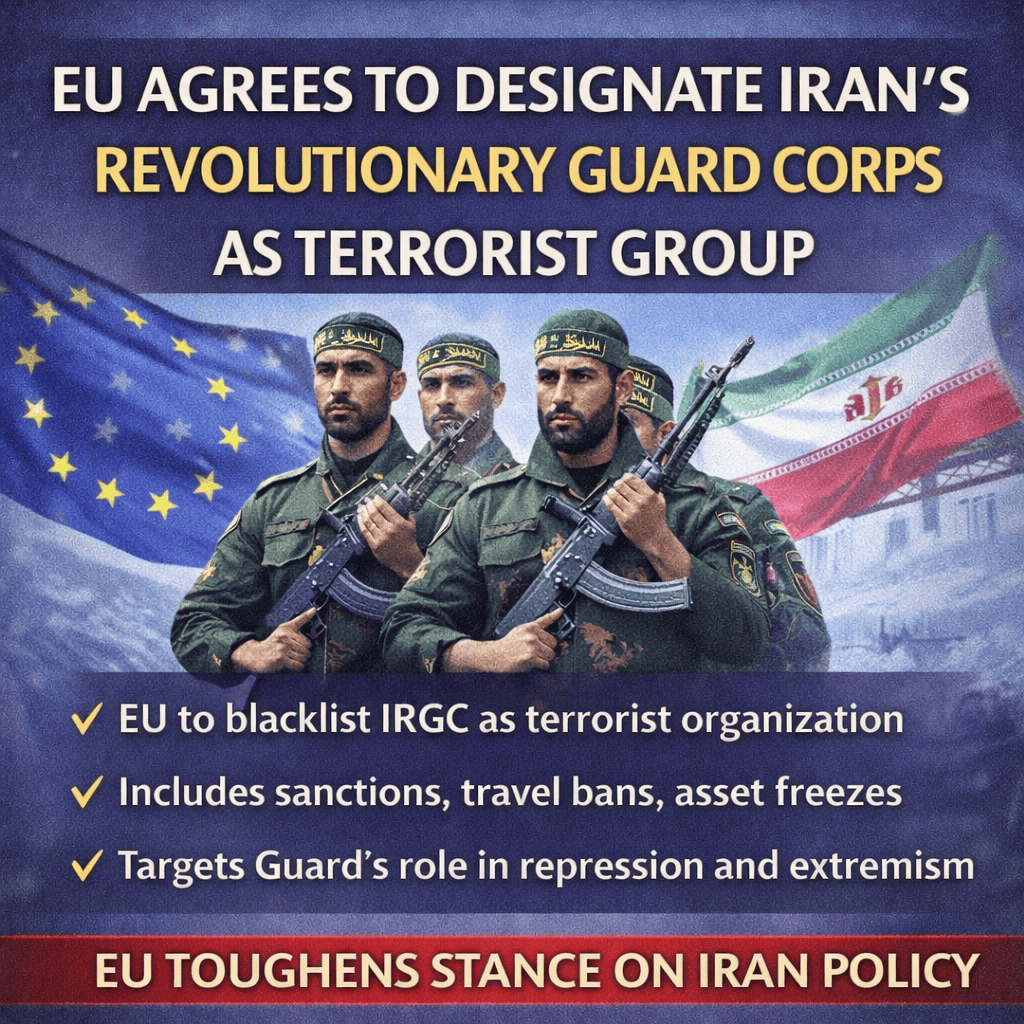
The European Union has agreed that the EU to designate Iran’s Revolutionary Guard Corps as a terrorist group, concluding months of political debate and internal resistance within the bloc. The decision, reached unanimously by EU foreign ministers, places the Islamic Revolutionary Guard Corps (IRGC) on the EU’s terrorism blocklist, aligning Europe more closely with the United States and several allied countries.
Under the designation, the IRGC becomes subject to the EU’s most restrictive counter‑terrorism measures. These include asset freezes, travel bans, and criminal penalties for providing material or financial support within EU jurisdictions. European authorities gain expanded legal powers to investigate and disrupt IRGC‑linked financial networks operating across the continent.
The move reflects mounting frustration among EU governments over the IRGC’s role in domestic repression inside Iran and its activities beyond the country’s borders. European officials point to the Guard’s involvement in violently suppressing protests, running intelligence operations, and supporting armed groups across the Middle East. The consensus now forming in Brussels is that existing sanctions were insufficient to address the scale of the organisation’s influence.
The agreement by the EU to designate Iran’s Revolutionary Guard Corps as a terrorist group marks a shift from years of caution. Several member states had previously opposed a full designation, arguing it could close diplomatic channels with Tehran or expose EU interests in the region to retaliation. France and Spain were among those that had expressed reservations in the past, citing legal and diplomatic risks.
That resistance softened as political pressure grew inside the European Parliament and among national governments. Lawmakers argued that failing to act undermined the EU’s credibility on human rights and security. The final decision followed fresh sanctions targeting Iranian officials and entities accused of censorship, surveillance, and violent repression.
The IRGC occupies a unique position within Iran’s power structure. Created after the 1979 revolution, it operates in parallel to the regular armed forces and exerts influence across military, intelligence, economic, and political spheres. It oversees Iran’s ballistic missile programme and plays a central role in regional operations through allied militias and proxy forces.
Iran reacted sharply to the announcement, rejecting the designation and warning that it would damage relations with Europe. Tehran described the decision as politically motivated and signalled possible diplomatic consequences. Despite this, EU officials maintain that channels for dialogue remain open and that the designation targets an institution, not the Iranian population.
By agreeing that the EU will designate Iran’s Revolutionary Guard Corps as a terrorist group, Brussels signals a tougher posture toward Tehran while expanding its enforcement toolkit at home. Whether the move changes Iranian behaviour remains uncertain, but it clearly redraws the boundaries of EU‑Iran relations and sets a precedent for how Europe treats state‑linked security organisations accused of systematic abuse.