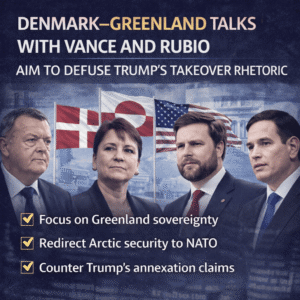
The Denmark Greenland Vance Rubio meeting will take place at the White House on Wednesday, bringing together Denmark’s and Greenland’s foreign ministers with U.S. Vice President JD Vance and Secretary of State Marco Rubio. The talks come after President Donald Trump renewed claims that the United States must take control of Greenland for national security—language that has unsettled Copenhagen, Nuuk, and allied capitals.
For Denmark and Greenland, the objective is clear: reassert sovereignty while keeping the conversation anchored in alliance cooperation. Greenland’s leadership has stated that the territory is not for sale and that decisions about its future belong to Greenlanders. Denmark has echoed that line, emphasizing that Arctic security should be addressed through NATO and existing defence agreements, not through acquisition rhetoric.
The meeting was requested by Danish Foreign Minister Lars Løkke Rasmussen and Greenland’s foreign minister Vivian Motzfeldt as a deliberate attempt to de-escalate. By engaging both Vance and Rubio, Copenhagen and Nuuk elevate the Denmark Greenland Vance Rubio meeting beyond routine diplomacy into a test of how Washington intends to manage Arctic strategy without fracturing alliance trust.
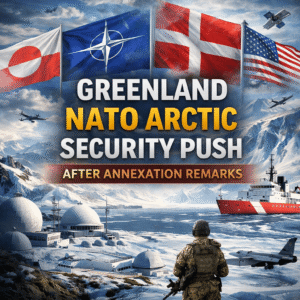
The backdrop is strategic. The Arctic is becoming a central theatre for security, energy routes, undersea infrastructure, and satellite coverage. Trump’s framing recasts those realities into a territorial question. Denmark’s counter-argument is structural: the United States already has access through NATO, basing agreements, and long-standing cooperation. Security can be expanded without redrawing borders.
Greenland’s government has reinforced that position, stating that partnership with the United States is welcome—annexation is not. The political mood in Nuuk has shifted toward stability, with leaders prioritizing economic resilience and alliance shelter amid uncertainty. That context shapes Greenland’s posture at the Denmark-Greenland Vance Rubio meeting.
What matters now is the signal Washington sends.
Three outcomes will define whether the talks calm or compound tensions:
- Sovereignty language: Will U.S. officials publicly affirm that Greenland’s status rests on self-determination within the Kingdom of Denmark?
- Security substance: Will the meeting produce concrete steps on Arctic surveillance, infrastructure protection, or joint exercises under NATO frameworks?
- Narrative reset: Will the conversation pivot from ownership to partnership—expanding cooperation without reframing borders?
Denmark is also preparing to increase its own Arctic presence, reinforcing that it takes security seriously while keeping it multilateral. The strategy is to meet U.S. concerns with capability, not concession.
Speculation (flagged): The most viable off-ramp is a package of expanded U.S.–Danish–Greenland cooperation—on basing, critical minerals, and Arctic infrastructure—paired with explicit sovereignty assurances. That would give Washington strategic gains, preserve alliance cohesion, and allow Denmark and Greenland to defend their red lines.
The Denmark, Greenland Vance Rubio meeting is therefore more than a diplomatic appointment. It is a test of whether Arctic security can be strengthened without weakening the rules that hold alliances together.