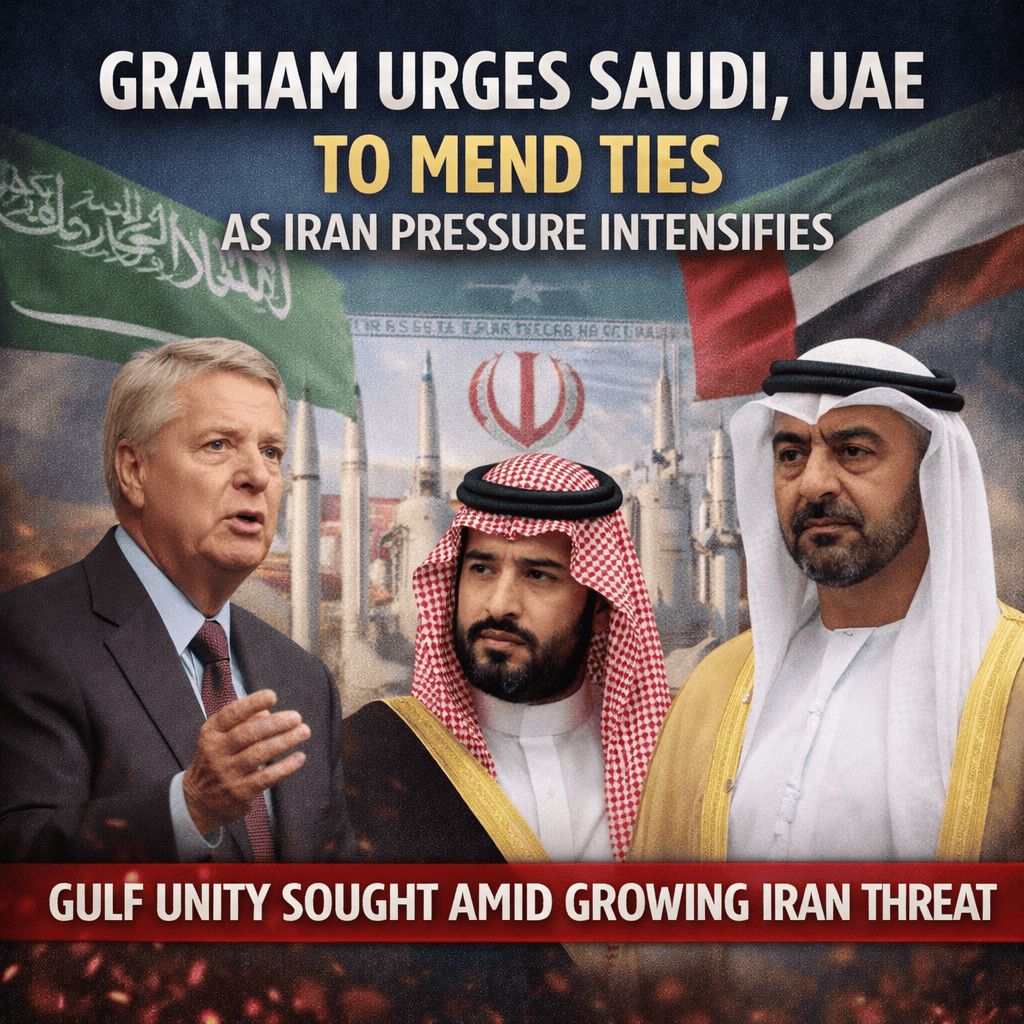
Graham urges Saudi UAE to mend ties as tensions with Iran escalate and regional fault lines widen across the Middle East. Speaking during the Munich Security Conference, US Senator Lindsey Graham pressed Saudi Arabia and the United Arab Emirates to repair strained relations, arguing that Gulf fragmentation benefits Tehran at a sensitive geopolitical moment.
The appeal comes as Iran faces renewed international scrutiny over its nuclear programme and regional posture. Washington is recalibrating its approach to Tehran while maintaining military deterrence in the Gulf. Against that backdrop, Graham urges Saudi UAE to mend ties, stressing that internal rivalries weaken collective leverage and reduce the credibility of coordinated deterrence.
Saudi-UAE relations have grown increasingly complex over the past year. While the two countries remain strategic partners on paper, their approaches to Yemen, Sudan and Red Sea security have diverged. In Yemen, tactical differences over influence and local alliances have strained coordination. In Sudan, competing political alignments have exposed broader competition for regional influence. These disagreements have spilled into diplomatic channels, raising concerns about long-term strategic cohesion.
For Washington, the stakes extend beyond bilateral Gulf politics. A divided Gulf Cooperation Council reduces the effectiveness of any unified front aimed at containing Iran’s regional activities. Graham urges Saudi UAE to mend ties in part because US policy relies heavily on coordinated regional security partnerships. Air defence integration, maritime patrol cooperation and intelligence sharing depend on trust between Riyadh and Abu Dhabi.
Energy markets also factor into the equation. Saudi Arabia and the UAE are major oil producers with growing influence over global supply decisions. If rivalry intensifies, coordinated production strategies could become harder to sustain, introducing volatility at a time when global markets are already sensitive to geopolitical shocks.
There are practical steps that could ease friction without requiring full policy alignment:
- Establish a structured bilateral security dialogue focused exclusively on de-escalation zones such as Yemen and the Red Sea.
- Create joint economic projects that align strategic interests, particularly in infrastructure and logistics.
- Develop shared crisis-management mechanisms to prevent proxy disputes from escalating into diplomatic standoffs.
Graham urges Saudi UAE to mend ties not as a symbolic gesture, but as a strategic necessity. The Gulf’s security architecture increasingly depends on interoperability and unified messaging. Tehran watches closely for divisions that can be leveraged diplomatically or militarily.
Speculation: If Saudi Arabia and the UAE institutionalise mechanisms for cooperation beyond personality-driven diplomacy, regional stability could strengthen considerably. If rivalry hardens, Iran may find greater space to maneuver in contested theatres from the Gulf to the Horn of Africa.
For now, Graham urges Saudi UAE to mend ties as pressure mounts, framing unity not as an option but as a prerequisite for effective regional deterrence and strategic clarity.