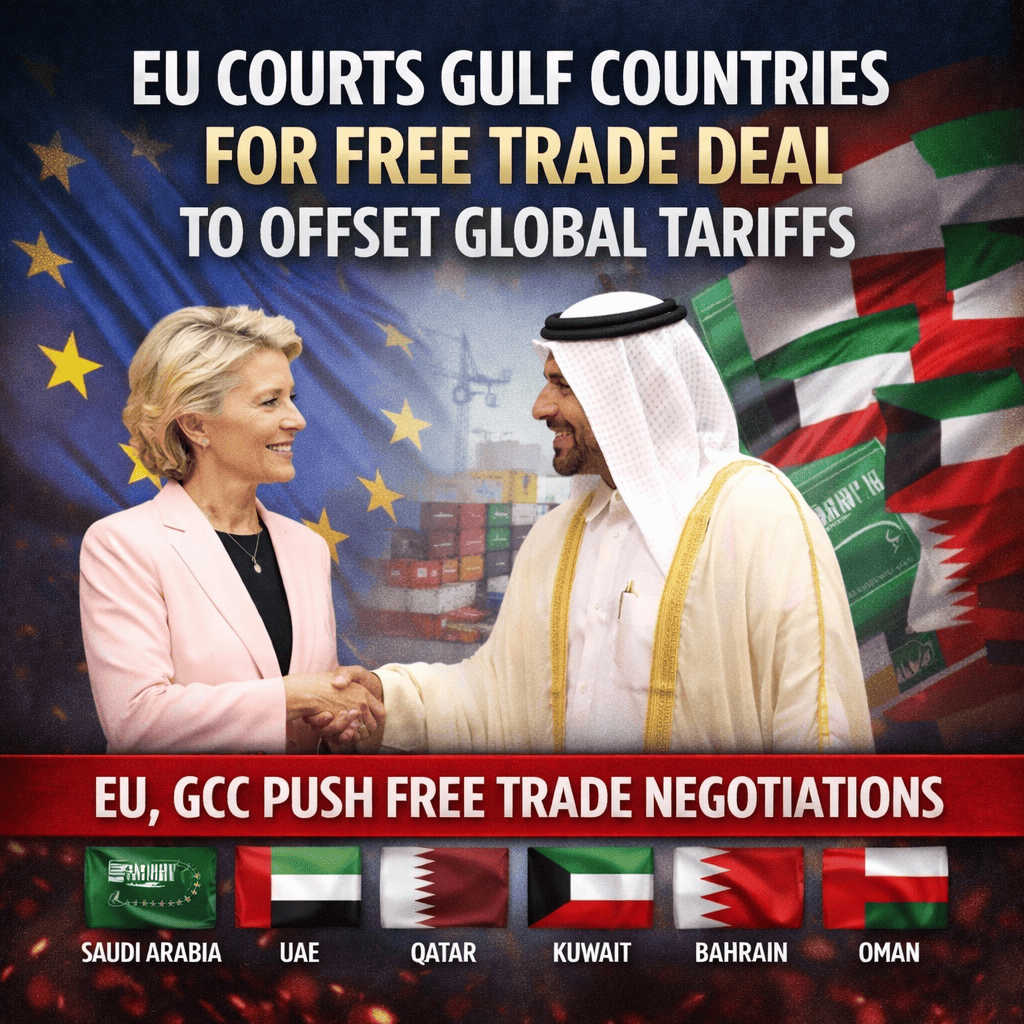
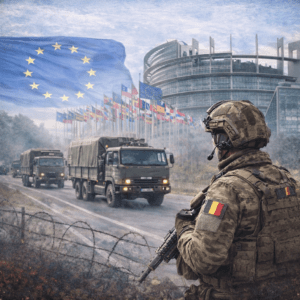
EU courts Gulf countries for free trade deal as Brussels faces growing pressure to shield European exports from rising global tariffs and diversify its trade relationships. The push marks a strategic shift in EU trade policy, driven by both economic urgency and geopolitical realignment.
Talks between the European Union and the Gulf Cooperation Council (GCC) have remained stalled for nearly two decades. The latest momentum comes amid global tariff escalation and protectionist moves from the United States and China, forcing EU policymakers to rethink long-term trade exposure. Gulf countries—Saudi Arabia, UAE, Qatar, Bahrain, Kuwait, and Oman—are now central to this recalibration.
Brussels is working to revive dormant negotiations, leveraging the World Governments Summit in Dubai to accelerate dialogue. EU Special Envoy Luigi Di Maio called the moment “critical,” emphasizing that the time to conclude a trade pact is now, especially with both blocs facing global trade fragmentation.
The EU’s initiative to court Gulf countries for a free trade deal focuses on removing barriers that have historically impeded progress—differences in regulatory frameworks, concerns over transparency, and asymmetries in market access. Previous rounds collapsed over disagreements on rules of origin and investment guarantees. Brussels now appears more flexible, considering phased agreements or hybrid arrangements to fast-track implementation.
From the EU’s side, the motivation is tactical. European firms—especially in machinery, automotive parts, chemicals, and green tech—need new growth markets to offset the impact of tariffs imposed by non-European powers. Gulf countries, flush with capital from high oil revenues, are pursuing economic diversification and seeking reliable trade and investment partners beyond Asia and North America.
The GCC bloc is accelerating non-oil development strategies under frameworks like Saudi Arabia’s Vision 2030 and the UAE’s National Industrial Strategy. Access to the EU’s single market offers clear advantages: technology transfer, advanced manufacturing, clean energy collaboration, and food security solutions.
If successful, the deal would provide Gulf exporters with greater access to Europe’s vast consumer market, while opening the GCC’s infrastructure and energy sectors to European investment. It could also enhance the EU’s leverage in global energy diplomacy.
However, the political calculus is sensitive. Human rights concerns, labor standards, and regional instability remain sticking points that could provoke resistance within the European Parliament. One workaround: EU negotiators may separate trade mechanisms from political dialogue tracks—allowing economic cooperation without requiring full convergence on values.
EU courts Gulf countries for free trade deal not just to bolster export resilience, but to ensure it isn’t left behind in a trade system increasingly shaped by regional pacts and bilateral assertiveness. The outcome will signal whether the EU can still drive trade diplomacy on its own terms in a multipolar economy.