The EU genuine federation debate has moved to the center of Europe’s economic future after Mario Draghi warned that the European Union risks long‑term decline unless it adopts a far deeper level of political and economic integration. Speaking at a policy forum in Belgium, Draghi argued that incremental coordination is no longer enough to protect Europe’s industrial base or its global relevance.
According to Draghi, the EU’s current structure leaves it exposed. Member states still retain veto power over critical decisions on industrial policy, defense, and foreign affairs, creating fragmentation at precisely the moment when global competition is intensifying. He described a system where Europe negotiates trade as a single bloc but approaches defense spending, energy security, and industrial investment as 27 separate actors. That imbalance, he said, accelerates deindustrialisation rather than preventing it.
The EU’s genuine federation concept, as Draghi outlined it, does not require dissolving national governments. Instead, it demands shared sovereignty in areas where scale matters: industrial strategy, fiscal coordination, defense procurement, and strategic technologies. Without this shift, Europe risks becoming dependent on external powers for energy, advanced manufacturing, and digital infrastructure—especially as the United States and China deploy coordinated state-backed industrial policies.
Draghi highlighted manufacturing as the most immediate casualty. European firms face higher energy costs, fragmented capital markets, and slower decision-making than their global competitors. National subsidies often cancel each other out, while EU-level tools remain limited. A genuine EU federation, he argued, would enable continent-wide investment vehicles, common debt issuance for strategic industries, and faster execution of cross-border projects.
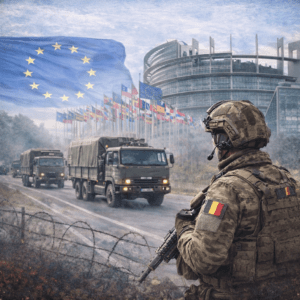
Defense and security featured prominently in his warning. Europe’s reliance on national procurement weakens supply chains and raises costs. A unified framework could consolidate demand, standardize equipment, and strengthen domestic defense manufacturing. Draghi linked this directly to industrial survival, noting that advanced manufacturing increasingly depends on defense-linked innovation.
Critics counter that member states are unlikely to surrender control over taxation or military authority. Draghi acknowledged the political resistance but argued that selective federation—focused only on strategic sectors—offers a realistic path forward. Energy grids, semiconductor production, artificial intelligence infrastructure, and defense manufacturing could be early candidates for shared governance.
Beyond politics, Draghi framed the EU’s genuine federation as an economic necessity rather than an ideological project. Fragmentation, he said, leaves Europe vulnerable to supply shocks, investment flight, and technological stagnation. A federated approach would provide businesses with regulatory clarity, deeper capital pools, and a more predictable industrial policy across borders.
The message was blunt: Europe can preserve its national symbols and still act as a single economic power. Without that shift, Draghi warned, deindustrialisation will not be reversed—and Europe’s influence will continue to shrink in a world shaped by scale, speed, and strategic coordination.