







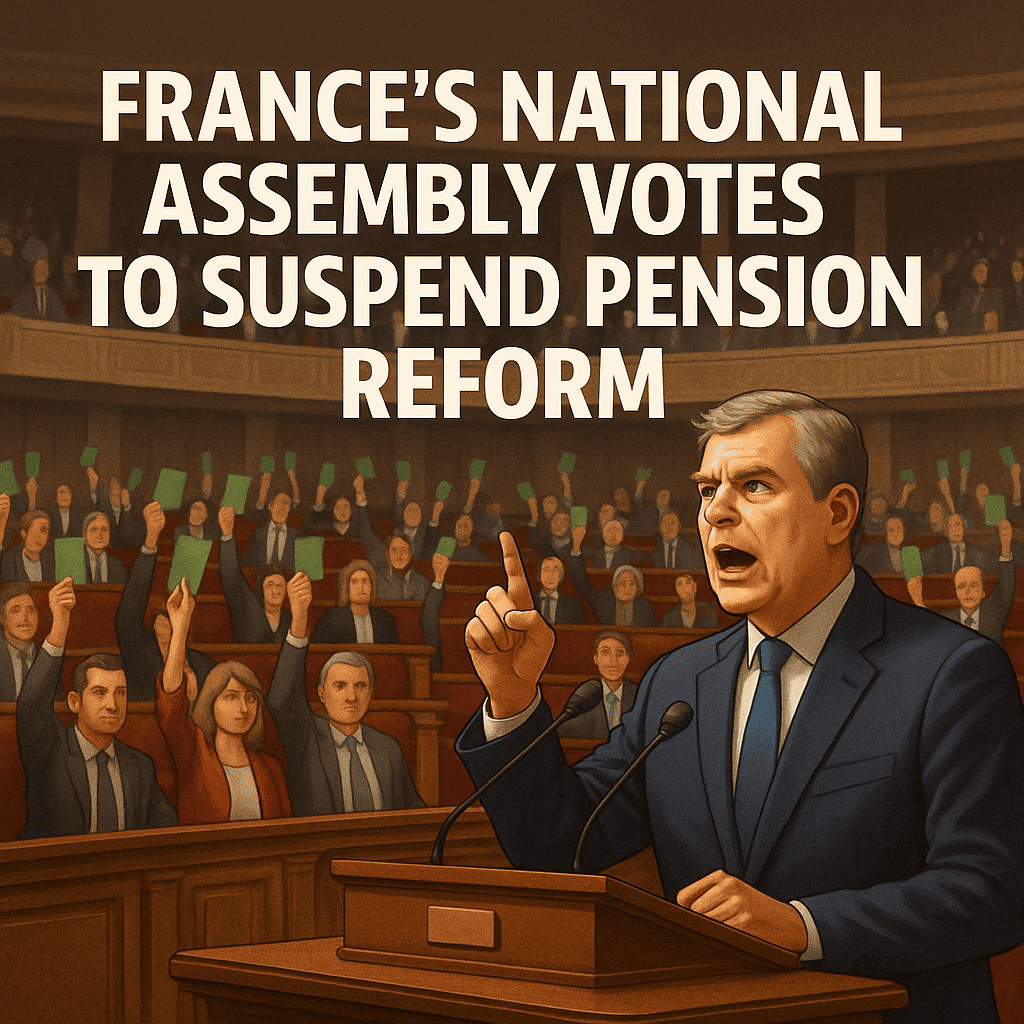



France’s political landscape shifted sharply after the National Assembly voted by a wide margin to support the suspension of pension reform, reversing a central policy that had defined years of national debate. Lawmakers backed an amendment that freezes the rise in the retirement age, effectively halting the implementation of the 2023 pension overhaul that had pushed the legal age from 62 to 64. The vote, carried by an unexpected alliance across left-wing, centrist, and far-right benches, reflects both electoral pressures and mounting concerns over the country’s strained public finances.
Under the approved amendment, the government will maintain the retirement age at 62 years and nine months, delaying further increases. The suspension of pension reform is tied directly to the broader social security financing bill, allowing the Assembly to temporarily relieve political tensions that have persisted since the protests and strikes of 2023. The decision offers short-term stability for Prime Minister Sébastien Lecornu, whose administration required cross-party support to survive ongoing budget negotiations.
Economically, however, the move introduces fresh uncertainty. France’s public deficit stood at 5.8% of GDP in 2024, the highest shortfall among European Union members. Savings expected from pension adjustments formed a crucial pillar of the government’s fiscal strategy. The suspension of pension reform could now widen that gap unless compensatory measures are crafted rapidly. Budget analysts warn that France may need alternative tools—such as automatic adjustment formulas, contribution-tracking systems, or phased retirement incentives—to maintain balance without igniting new unrest.
The measure must still pass through the Senate and be integrated into the final version of the annual social security funding law. If the upper house pushes back, the government may face another standoff at a time when investor confidence is sensitive to domestic policy reversals.
Beyond numbers, the vote signals a more profound transformation in France’s political mood. Lawmakers who once firmly opposed each other united around a shared desire to defuse social tension ahead of the next presidential cycle. Should the suspension of pension reform persist through 2027, the country may be compelled to overhaul its entire retirement model, with demographic pressures and labor-market constraints shaping the next generation of reforms.

Spain slams US and Israeli strikes on Iran, with Prime Minister Pedro Sánchez warning of escalation risks and signalling a more independent Spanish foreign policy stance within the EU.

Graham urges Saudi UAE to mend ties as Iran pressure intensifies, warning that Gulf divisions weaken regional security and complicate U.S.-Iran diplomacy amid Yemen and Red Sea tensions.

EU courts Gulf countries for free trade deal to protect European exports from global tariff pressures and deepen strategic partnerships with GCC states.

The European preference in military mobility plan gains support in the EU Parliament, aiming to prioritise EU infrastructure, suppliers, and control to strengthen defence readiness and strategic autonomy.



Subscribe
Fill the form our team will contact you
Advertise with us
Fill the form our team will contact you
Leave us a message